The first time I watched a trader reject a piece of technology, it wasn’t broken. That was the part I couldn’t get past.
My name is Kenji Kurosawa. I’d spent years as a systems engineer on a Tokyo trading floor before drifting into the part of the job I actually turned out to be good at: the outsider brought in when somebody wants a technically literate pair of eyes that is not on the project to sit in the room and say, honestly, whether a vendor’s promise is going to survive contact with a real desk. Steve had asked me onto this one directly, and I’d been in the room three days, on the kind of assignment I’d done a dozen times before: sit close enough to a build to write down, honestly, whether it deserves the money a bank is about to commit to it. Infinet had built the earliest thing you could honestly call a prototype: a laptop, a browser tab standing in for a turret, wired into a sandboxed line that carried real signalling but no real counterparty on the other end. Amar was running the demo himself, which should have told me something about how confident he was. Steve had asked a trader named Priya to sit in, a fifteen-year veteran of a rates desk who’d agreed to give it ten minutes between calls she actually needed to make, the desk still loud behind her.
A pilot lives or dies in rooms exactly like this one, long before procurement ever sees a business case. If Priya walked back to her desk unconvinced, there was no price left to negotiate.
Amar walked her through it in about ninety seconds. Tap the tile, it lights, you’re through. No handset, no cord, no rack of gear under the desk. She listened, nodded, and tapped it.
She got her counterparty. Clean audio, no drops, nothing a network engineer would have flagged. Priya used it for maybe four seconds, said “yeah, hang on,” muted it, and turned back to Amar.
“It’s slow.”
Amar looked at the session log over her shoulder. Two hundred and forty milliseconds from tap to open audio path. He said so, gently, the way you correct a number you assume is the whole disagreement. “That’s under a quarter of a second. That’s faster than you can blink.”
“I know what I felt,” Priya said, and went back to her real desk.
Steve didn’t look surprised, which annoyed Amar more than the rejection had. He caught my eye first, the look one engineer gives another in a room that doesn’t have many. “You saw that coming too, Kurosawa-san.” Then, to Amar: “You just proved my point and you don’t know it yet.”
“I proved the opposite of your point. It worked. The audio was fine.”
“The audio isn’t the point. The button is.” Steve tapped the desk where a turret key would sit. A turret being the thing this book is named for and around: the console on a trading desk, a bank of dozens of dedicated keys, each one a permanently open route to a specific counterparty or group, so that reaching somebody is a press rather than a call. “On a real turret, that key isn’t asking anything. It’s closing a circuit that’s already up. The line to that counterparty has been standing since the desk opened this morning, sometimes for years. There’s no handshake you can perceive. Your finger completes a loop that was already waiting for it. The instant you touch it, you know, because there is nothing left to happen. She didn’t feel two hundred and forty milliseconds of network. She felt the gap where the certainty used to be.”
Amar wasn’t ready to concede the ground that fast, and not on the point Steve thought he was making. “Half your key sheet isn’t a standing private wire at all, it’s a speed-dial preset seizing a trunk group, same as it’s always been. That’s not a closed loop that’s been sitting there for years, that’s just a very fast, very old kind of handshake, electrical instead of digital.” He didn’t wait for a response. “So the requirement is zero latency? That’s not an architecture problem, that’s a physics problem, and I don’t think it’s actually true. Nobody can perceive two hundred and forty milliseconds as a gap in continuous audio. What she perceived was something else, and if we’re going to fix it, I need to know what, because ‘make the network faster’ isn’t going to get us anywhere near what a closed circuit does.”
“Fine, some of it’s a fast seize over a trunk, not a standing loop,” Steve said, waving that off for later. “Doesn’t change what she felt. Go find out what she actually felt. Don’t tell me it’s not true. Go ask her.”
This is usually where Amar would have kept arguing the number. He didn’t. He went and found Priya at her desk, waited for a pause, and asked her, plainly, what happened in that four seconds. Not “was it slow,” but what she noticed, in order.
Her answer, when he came back and repeated it to us, was more precise than either of us expected from someone who’d given the demo ten minutes of her day. “I pressed it and I didn’t know if it had heard me. On the turret, the second my finger’s down, the light’s up and I’m already talking, because I know I’m live. Here I pressed it and just… waited. Not long. But I waited to find out if it worked before I could start.”
I’d been in enough rooms like this in Tokyo to recognize the shape of the argument before I could name it, and it took me a beat to place why. Steve was right that something real had been lost. Amar was right that the number didn’t support “the network is too slow.” They were both describing the same 240 milliseconds and getting different diagnoses because they were measuring different things.
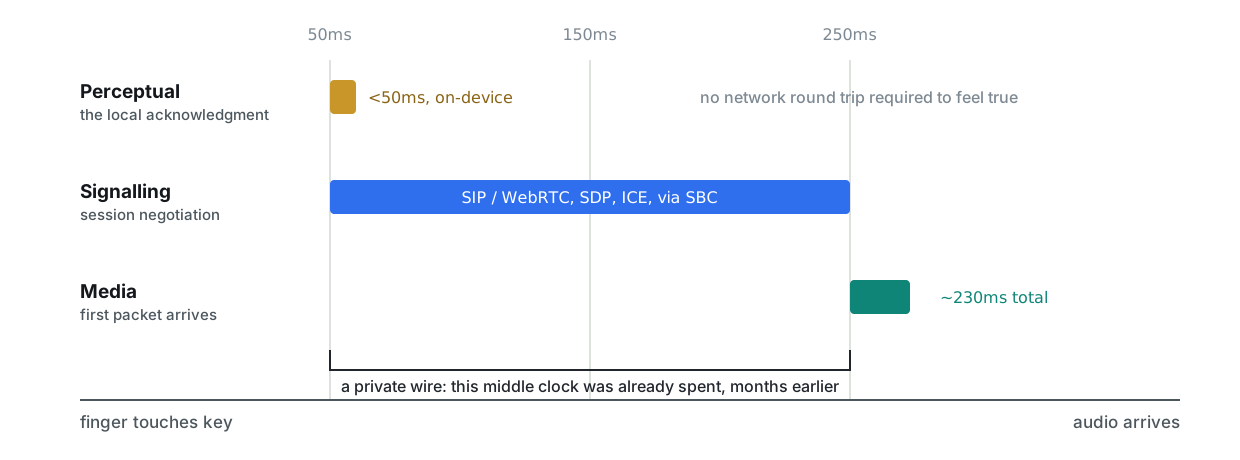
There are, it turns out, three separate clocks running under a single button press, and the old turret had quietly collapsed them into one because its physical design left it no choice. The first clock is perceptual latency: how long before the human feels something happened. The second is signalling latency: how long the system actually takes to negotiate a session, find the counterparty, open a path. On a modern softphone that’s real, honest work: an offer and answer carried over SIP, or over whatever channel the application has picked when the endpoint is a browser tab, because WebRTC deliberately specifies no signalling of its own and leaves that choice to you, with a route checked wherever the endpoint sits behind a NAT, a search a fixed desk phone on the bank’s own network never had to run. The third is media latency: once the path is open, how long before the first packet arrives at the far end.
A dedicated private wire collapses the second clock to nothing, because the negotiation happened once, at provisioning time, months before the trader ever touched the key. That wasn’t only a trick of psychology, either: a wire like that also carried its own reserved capacity, immune to whatever else was happening on the bank’s network that morning, a real engineering guarantee that a shared softphone path has to earn back, not just a feeling to be talked out of. Touch the key and you’re only waiting on the third clock, media, which is short enough that a human can’t perceive it as a gap. A softphone re-runs the second clock every single time, honestly and correctly, and Priya felt that honesty as a hole where her certainty used to be.
Nobody had asked, until Amar did, which of the three clocks a trader is actually equipped to notice. The answer, it turns out, isn’t in the network at all.
The system must confirm it heard you before it has any business proving it acted.
The old circuit didn’t separate those two events because it couldn’t; closing the loop was the confirmation. A modern system has no such excuse, and no such shortcut. It has to build the confirmation on purpose, as its own signal, distinct from whether the call has actually gone through yet.
Once Amar had the three clocks apart, the fix stopped being a network problem and became an interface problem, which is a much better place for Infinet to be arguing from.
The design that came out of the next week’s whiteboard session split the button press into two independently engineered events instead of one. The moment a trader’s finger lands, the client generates its own acknowledgment locally: a tone, a lit state, a haptic tick, whatever the endpoint supports, fired from code running on the device itself, with no round trip to any server required to produce it. Infinet’s target for that local acknowledgment is under fifty milliseconds, well inside Nielsen’s old usability threshold for what a human reads as instantaneous, because it never has to wait on the network to be true.
The actual session, meanwhile, still has to do its honest work in the background: SIP or WebRTC signalling, ICE negotiation where the endpoint needs it, an SBC at the edge finding and validating a path, media opening end to end. That’s the second clock, running exactly as long as it genuinely needs to, with nothing shaved off it and nothing hidden about it. On Infinet’s own low-hop network, without a relay hop for NAT traversal, that’s roughly two hundred milliseconds of it, the signalling share of the two hundred and forty Priya’s demo actually measured; a call crossing the open internet through a relay would take longer, and the design has to survive that case too, not just the friendly one.
The two events are deliberately not the same signal, and they’re not allowed to look like the same signal either. The design room settled on this: the local acknowledgment tells the trader the system registered your action. A second, distinct confirmation, arriving whenever the real path actually opens, tells them you are live. On the prototype that second one still took roughly the two hundred milliseconds it takes, but it no longer had to carry the whole weight of the trader’s certainty by itself, because the first signal had already done that job in under fifty.
The first time Amar showed this to a bank architect outside Infinet, the objection arrived before he’d finished the second sentence. “You’re describing an optimistic UI. Fine for a chat app that can quietly retry a failed send. What happens when your fifty-millisecond tone fires, the trader starts talking, and the session behind it fails to establish? Now they’ve spoken into a line that was never live, and your system told them it was fine.”
It’s the one the design has to survive, not argue around. A private wire never created this failure mode because there was nothing left to fail once the loop closed.
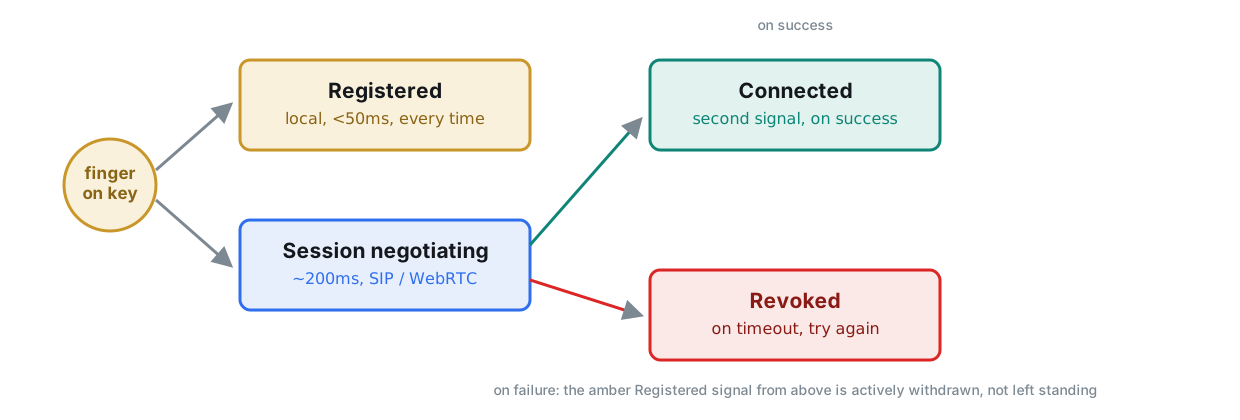
Infinet’s answer was to make the two signals different enough that a trader can’t mistake one for the other without training themselves not to, and to make failure loud rather than silent: if the real session doesn’t complete within four hundred milliseconds, a number Infinet picked itself and kept well inside Nielsen’s one-second limit for an uninterrupted flow of thought, the local acknowledgment is actively revoked, not just left stale, replaced by its own unmissable signal, a different tone, a different colour, that means specifically that didn’t reach anyone, say it again. The microphone itself doesn’t open until Connected actually fires. Nothing a trader says in those four hundred milliseconds is captured at all, so there’s no held audio sitting anywhere to flush onto the wire out of step with the rest of the call once it connects, and nothing for a revocation to have to quietly discard. Registered was never a promise that the room could hear you. It was only ever a promise that the system had heard your finger. On a desk where the words after that press can be an order, that distinction has to survive contact with someone who’s already talking: a trader who believes she’s live because nothing told her otherwise is a worse failure than a slow tap ever was, which is exactly why revocation gets a signal loud enough to interrupt her, not a light that just quietly goes dark.
Registered and connected had to become two things a trader could tell apart on instinct, the same way sensing a light versus hearing a dial tone once were, an argument Chapter 5 picks back up, and it says nothing yet about what happens when the signalling path itself goes dark rather than merely slow, which is Chapter 12’s problem, not this one’s.
What we shipped from that week wasn’t a faster network. It was an honest confession, built into the interface, about which half-second the system actually controls and which one it doesn’t.
Priya tried the revised build two weeks later. She didn’t say it was fast. She said, “okay, now I know when you’ve got me. Ask me again when the desk’s actually busy,” which was the only review that mattered.
Steve caught my eye again on the way out. “Write that down, Kurosawa-san.” I already had.